Why Replace SHA-256? Performance Gaps in Modern Systems
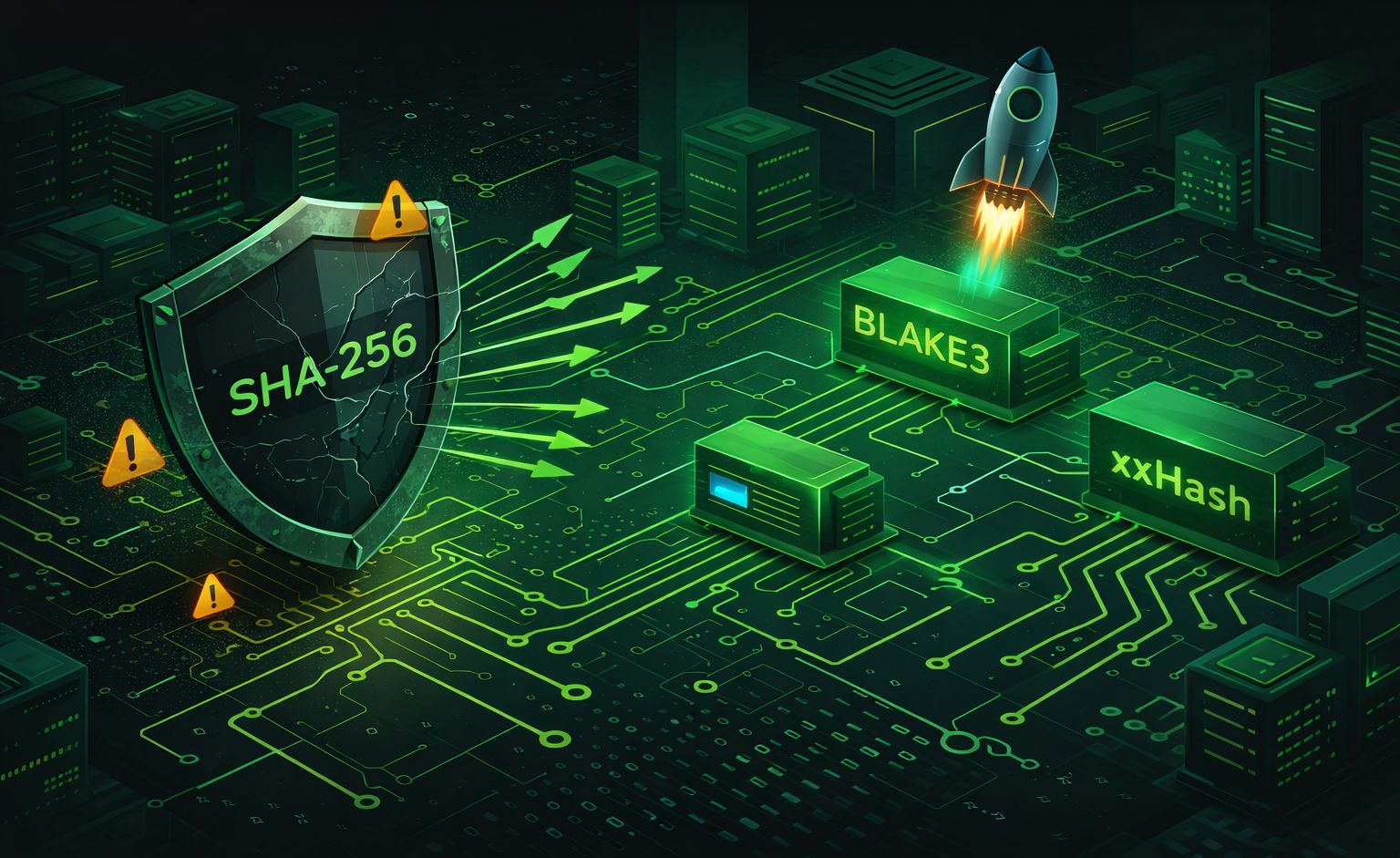
SHA-256 remains cryptographically unbroken in 2025 — no practical collision or preimage attacks exist. The push for SHA-256 alternatives is purely about throughput. When Cloudflare processes 57 million HTTP requests per second, or Kafka brokers handle 2 million messages per second, SHA-256's ~3 GB/s ceiling (even with hardware acceleration) becomes measurable overhead.
Three technical factors drive the search for faster cryptographic hash functions:
The alternatives aren't theoretical. BLAKE3 has been in production at scale since 2020. xxHash powers checksums in Zstd, LZ4, and Meta's internal infrastructure. This guide covers when each alternative actually outperforms SHA-256, with measured benchmarks and production-tested code.
SHA-256 Throughput and Latency: Measured Performance Numbers
Benchmark Results: SHA-256 on 2025 Hardware
Measurements taken on AMD Ryzen 9 7950X (Zen 4, SHA-NI enabled) and Apple M3 Pro, using OpenSSL 3.2 and the Rust sha2 crate:
- x86-64 with SHA-NI: 2.8-3.2 GB/s (Intel Alder Lake, AMD Zen 3+)
- x86-64 without SHA-NI: 650-800 MB/s (older Xeon, budget CPUs)
- Apple M3 Pro: 2.1 GB/s (ARMv8.4 crypto extensions)
- AWS Graviton3: 1.8 GB/s
- Raspberry Pi 4: 85 MB/s (Cortex-A72, no crypto acceleration)
For comparison on identical hardware: BLAKE3 achieves 8.4 GB/s (single-threaded, AVX2), xxHash3 hits 31 GB/s. The gap is 3-10x depending on workload.
Why SHA-256 Cannot Be Optimized Further
SHA-256's architecture creates hard performance ceilings:
- 64-Round Compression: Each 64-byte block requires 64 rounds of mixing operations. Cryptanalysis shows SHA-256 needs all 64 rounds — reduced-round variants are vulnerable. BLAKE3's 7 rounds achieve equivalent security through superior diffusion.
- Inherent Sequential Dependency: Block N's input depends on Block N-1's output. No amount of optimization enables parallelism within a single hash operation. BLAKE3's tree mode breaks this dependency.
- 32-bit Word Operations: SHA-256 operates on 32-bit words. Modern CPUs have 256-512 bit SIMD registers that sit mostly idle. BLAKE3 processes four BLAKE3 states simultaneously in a single 256-bit register.
- Message Expansion: The 64-word message schedule adds ~16 cycles of setup per block before compression begins.
Where SHA-256 Overhead Is Negligible
SHA-256 performance matters less than you think in many scenarios:
- Network-bound operations: TLS handshakes are limited by round-trip latency, not hash speed. SHA-256 in certificate verification adds <1ms.
- Database-bound APIs: If your request includes database queries, SHA-256 hashing is <0.1% of response time.
- Human-scale interactions: Password hashing uses bcrypt/Argon2 (intentionally slow). The underlying hash primitive's speed is irrelevant.
Profile before optimizing. Replace SHA-256 only when benchmarks show hashing as a measurable bottleneck. Generate test hashes instantly with our browser-based hash generator — no installation, no data transmission.
BLAKE3 vs SHA-256: Speed, Security, and When to Switch
BLAKE3 was released January 9, 2020 by the team behind BLAKE2 (Jean-Philippe Aumasson, Samuel Neves, Zooko Wilcox-O'Hearn, Jack O'Connor). It's a cryptographic hash function providing 128-bit collision resistance and 256-bit preimage resistance — equivalent to SHA-256's security claims.
BLAKE3 Benchmark Numbers (Single-Threaded)
- x86-64 AVX2: 6.4 GB/s (reference implementation, Rust)
- x86-64 AVX-512: 8.4-12 GB/s (depending on CPU generation)
- x86-64 SSE4.1: 3.2 GB/s
- Apple M3: 4.1 GB/s (NEON)
- WebAssembly (SIMD): 1.2 GB/s (Chrome 120+)
- Small inputs (<64 bytes): ~48 cycles (vs SHA-256's ~180 cycles with SHA-NI)
Technical Architecture: How BLAKE3 Achieves 4-10x Speedup
BLAKE3's performance comes from four specific design decisions:
- 7-Round Compression vs 64: BLAKE3's compression function uses 7 rounds. This isn't reduced security — each BLAKE3 round achieves complete diffusion across all 64 bytes of state. SHA-256 requires 64 rounds because its per-round diffusion is weaker. Cryptanalysis by the BLAKE team shows 7 BLAKE3 rounds exceed SHA-256's security margin.
- Bao Tree Structure: BLAKE3 processes 1024-byte chunks independently, then combines chunk hashes in a binary tree. On 16 cores, a 1 GB file hashes at 92 GB/s (11x single-thread speed). SHA-256's Merkle–Damgård construction cannot parallelize at all.
- SIMD-First Design: The G function uses 32-bit XOR, addition, and rotation — operations that pack perfectly into AVX2/AVX-512 registers. Four parallel BLAKE3 instances fit in one 256-bit register. SHA-256's addition-with-carry operations resist SIMD packing.
- Single Compression Function: The same G function handles hashing, keyed hashing, key derivation, and XOF output. SHA-256 requires separate HMAC construction for keyed hashing.
BLAKE3 Code Examples
Rust (using the official blake3 crate):
use blake3;

fn main() {
    // Hash a string
    let hash = blake3::hash(b"Hello, World!");
    println!("BLAKE3: {}", hash.to_hex());

    // Incremental hashing for large data
    let mut hasher = blake3::Hasher::new();
    hasher.update(b"Hello, ");
    hasher.update(b"World!");
    let hash = hasher.finalize();
    println!("BLAKE3 (incremental): {}", hash.to_hex());

    // Parallel file hashing (automatically uses multiple threads)
    let mut hasher = blake3::Hasher::new();
    hasher.update_rayon(&large_data); // Parallelized with Rayon
    let hash = hasher.finalize();
}
Node.js (using blake3 package):
import { hash, createHash } from 'blake3';

// Simple hashing
const digest = hash('Hello, World!');
console.log('BLAKE3:', digest.toString('hex'));

// Streaming for large files
import { createReadStream } from 'fs';

const hasher = createHash();
createReadStream('large-file.bin')
  .pipe(hasher)
  .on('finish', () => {
    console.log('File hash:', hasher.digest('hex'));
  });
Python (using blake3 package):
import blake3

# Simple hashing
hash_value = blake3.blake3(b"Hello, World!").hexdigest()
print(f"BLAKE3: {hash_value}")

# Incremental hashing
hasher = blake3.blake3()
hasher.update(b"Hello, ")
hasher.update(b"World!")
print(f"BLAKE3 (incremental): {hasher.hexdigest()}")

# Multi-threaded file hashing
hasher = blake3.blake3()
hasher.update_mmap("large-file.bin")  # Memory-mapped, parallel
print(f"File hash: {hasher.hexdigest()}")
Go (using zeebo/blake3):
package main

import (
    "fmt"
    "github.com/zeebo/blake3"
)

func main() {
    // Simple hashing
    hash := blake3.Sum256([]byte("Hello, World!"))
    fmt.Printf("BLAKE3: %x\n", hash)

    // Incremental hashing
    hasher := blake3.New()
    hasher.Write([]byte("Hello, "))
    hasher.Write([]byte("World!"))
    fmt.Printf("BLAKE3 (incremental): %x\n", hasher.Sum(nil))
}
Use BLAKE3 When:
- Hashing >100 MB/s aggregate: At lower volumes, SHA-256's overhead is unmeasurable. Above this threshold, BLAKE3's 3-10x speedup provides real capacity gains.
- Multi-core file hashing: Backup tools (restic, Bao), build systems, and CDN origin servers benefit from BLAKE3's parallelism.
- ARM/RISC-V without crypto extensions: Raspberry Pi, older AWS Graviton, embedded Linux. BLAKE3 is 5-10x faster than software SHA-256 on these platforms.
- Internal systems: When you control both hash producer and consumer, interoperability isn't a constraint.
Keep SHA-256 When:
- FIPS 140-2/3 compliance: BLAKE3 is not NIST-approved. Government contracts, healthcare (HIPAA), and payment processing (PCI-DSS) typically require SHA-2 or SHA-3.
- Blockchain protocols: Bitcoin (SHA-256d), Ethereum (Keccak-256), and most chains have consensus rules tied to specific hash functions.
- External API contracts: When third parties expect SHA-256 hashes in requests or webhooks.
- Maximum cryptanalysis history: SHA-256 has survived 23 years of public cryptanalysis. BLAKE3 has 5. For high-value targets (certificate authorities, HSMs), this track record matters.
SHA-3 (Keccak): FIPS-Approved, But Slower Than SHA-256
SHA-3 (standardized as FIPS 202 in August 2015) won NIST's five-year hash function competition over 64 submissions. Its Keccak sponge construction is mathematically independent from SHA-256's Merkle–Damgård design — critical for cryptographic diversity. If a structural attack ever breaks SHA-2, SHA-3 remains unaffected.
SHA-3 Is Slower Than SHA-256 in Software
SHA-3's sponge construction trades throughput for a higher security margin. Measured benchmarks:
- SHA3-256: 280-420 MB/s on x86-64 (OpenSSL 3.2, no Keccak hardware)
- SHA3-512: 180-260 MB/s
- Comparison: SHA-256 with SHA-NI is 7-10x faster; BLAKE3 is 20-30x faster
- With dedicated Keccak silicon: 2-3 GB/s (some ARM Cortex-A cores, smartcard chips)
SHA-3 is not a faster SHA-256 alternative. Choose it for specific technical reasons (FIPS compliance, XOF output, cryptographic diversity), not performance.
SHAKE: SHA-3's Flexible Output Mode
SHA-3 includes extendable-output functions (XOFs) called SHAKE128 and SHAKE256. Unlike fixed-output hash functions, XOFs can produce arbitrary-length outputs:
// Python: Generate a 512-bit output from SHAKE256
from hashlib import shake_256

# Generate 64 bytes (512 bits) of output
output = shake_256(b"seed data").digest(64)

# Generate a unique 128-byte key
key = shake_256(b"master secret" + nonce).digest(128)
SHAKE is particularly useful for:
- Key derivation: Generate encryption keys of any required length
- Deterministic random generation: Expand short seeds into arbitrary-length pseudorandom streams
- Post-quantum cryptography: Many lattice-based schemes use SHAKE internally
SHA-3 Code Examples
Python (built-in hashlib):
import hashlib

# SHA3-256 (256-bit output)
hash_sha3 = hashlib.sha3_256(b"Hello, World!").hexdigest()
print(f"SHA3-256: {hash_sha3}")

# SHA3-512 (512-bit output)
hash_sha3_512 = hashlib.sha3_512(b"Hello, World!").hexdigest()
print(f"SHA3-512: {hash_sha3_512}")

# SHAKE256 with variable output length
from hashlib import shake_256
output_128_bytes = shake_256(b"Hello, World!").hexdigest(128)
print(f"SHAKE256 (128 bytes): {output_128_bytes}")
Node.js (built-in crypto module):
import { createHash } from 'crypto';

// SHA3-256
const sha3Hash = createHash('sha3-256')
  .update('Hello, World!')
  .digest('hex');
console.log('SHA3-256:', sha3Hash);

// SHAKE256 with 64-byte output
const shakeHash = createHash('shake256', { outputLength: 64 })
  .update('Hello, World!')
  .digest('hex');
console.log('SHAKE256 (64 bytes):', shakeHash);
Go (golang.org/x/crypto/sha3):
package main

import (
    "encoding/hex"
    "fmt"
    "golang.org/x/crypto/sha3"
)

func main() {
    // SHA3-256
    hash := sha3.Sum256([]byte("Hello, World!"))
    fmt.Printf("SHA3-256: %s\n", hex.EncodeToString(hash[:]))

    // SHAKE256 with arbitrary output
    shake := sha3.NewShake256()
    shake.Write([]byte("Hello, World!"))
    output := make([]byte, 64) // 64 bytes output
    shake.Read(output)
    fmt.Printf("SHAKE256: %s\n", hex.EncodeToString(output))
}
When to Choose SHA-3
- Cryptographic diversity: As a backup if SHA-2 family faces future attacks
- NIST compliance: When you need a FIPS-approved alternative to SHA-256
- Variable-length output: SHAKE provides true XOF capabilities
- Post-quantum integration: Many PQC schemes use SHA-3/SHAKE internally
- Hardware-accelerated environments: Specialized Keccak accelerators exist in some chips
xxHash3, wyhash, and Non-Cryptographic Hash Functions: 10-50x Faster
Many hash use cases have no adversary. Hash tables, cache keys, checksums for accidental corruption, and content deduplication don't need collision resistance against attackers — just good distribution and speed. Non-cryptographic hash functions are 10-50x faster than SHA-256 because they skip the operations that provide attack resistance.
xxHash3: 31 GB/s Throughput
xxHash3 (released 2019 by Yann Collet, author of Zstd) is the fastest portable hash function with quality guarantees:
- Large inputs (AVX2): 31.2 GB/s — approaches memory bandwidth limits
- Large inputs (scalar): 8.4 GB/s — still 10x faster than hardware-accelerated SHA-256
- Small inputs (1-16 bytes): 15-20 cycles — optimized code paths for each size class
- Output sizes: 64-bit (XXH3_64bits) or 128-bit (XXH3_128bits)
- Quality: Passes SMHasher, BigCrush, and PractRand statistical tests
xxHash3 Example (C):
#define XXH_STATIC_LINKING_ONLY
#include "xxhash.h"

// Simple one-shot hashing
XXH64_hash_t hash64 = XXH3_64bits("Hello, World!", 13);
printf("xxHash3-64: %016llx\n", hash64);

// 128-bit variant
XXH128_hash_t hash128 = XXH3_128bits("Hello, World!", 13);
printf("xxHash3-128: %016llx%016llx\n", hash128.high64, hash128.low64);

// Streaming API for large files
XXH3_state_t* state = XXH3_createState();
XXH3_64bits_reset(state);
XXH3_64bits_update(state, chunk1, chunk1_len);
XXH3_64bits_update(state, chunk2, chunk2_len);
XXH64_hash_t final_hash = XXH3_64bits_digest(state);
XXH3_freeState(state);
xxHash3 Example (Rust):
use xxhash_rust::xxh3::{xxh3_64, xxh3_128, Xxh3};

fn main() {
    // One-shot hashing
    let hash64 = xxh3_64(b"Hello, World!");
    println!("xxHash3-64: {:016x}", hash64);

    let hash128 = xxh3_128(b"Hello, World!");
    println!("xxHash3-128: {:032x}", hash128);

    // Streaming
    let mut hasher = Xxh3::new();
    hasher.update(b"Hello, ");
    hasher.update(b"World!");
    println!("xxHash3-64 (streaming): {:016x}", hasher.digest());
}
Other Notable Non-Cryptographic Options
wyhash:
- Extremely simple implementation (~100 lines of code)
- Competitive speed with xxHash3 for small inputs
- Default hasher in Zig and some Rust hash maps
MurmurHash3:
- Battle-tested, widely deployed (Cassandra, Elasticsearch)
- 128-bit output variant available
- Slower than xxHash3 but extremely stable API
CityHash / FarmHash (Google):
- Optimized for hash table usage
- FarmHash is the successor with better portability
- Used internally at Google for various systems
Security Warning: xxHash and wyhash Provide Zero Attack Resistance
Non-cryptographic hashes are trivially invertible and collision-forgeable. An attacker can:
- Generate collisions in microseconds (not years)
- Craft inputs that hash to specific values
- Exploit hash table collisions for DoS attacks (HashDoS)
Never use non-cryptographic hashes for:
- Password storage: Use Argon2id, bcrypt, or scrypt
- Authentication tokens: Use HMAC-SHA256 or BLAKE3 keyed mode
- Digital signatures: Use SHA-256, SHA-3, or BLAKE3
- Content integrity with untrusted input: Attackers can craft files with matching hashes
- Hash tables with attacker-controlled keys: HashDoS creates O(n²) worst-case lookups
The decision rule: "Can an attacker choose the input?" If yes, use a cryptographic hash. If no (internal caching, trusted data), non-cryptographic hashes are safe.
Hash Function Speed Comparison: Benchmarks and Performance Tables
Test methodology: All benchmarks run on AMD Ryzen 9 7950X (Zen 4), DDR5-6000 CL30, Ubuntu 24.04, Clang 18, -O3 -march=native. Each measurement is the median of 100 runs after 10 warmup iterations. Source data hashed from /dev/urandom to avoid branch predictor artifacts.
Large Input Throughput: 1 GB Data, Single Thread
Algorithm        Throughput    Relative to SHA-256
─────────────────────────────────────────────────────
xxHash3-64       31.2 GB/s     10.4x faster
xxHash3-128      26.8 GB/s     8.9x faster
wyhash           28.5 GB/s     9.5x faster
BLAKE3           8.4 GB/s      2.8x faster
SHA-256 (SHA-NI) 3.0 GB/s      baseline
SHA-256 (soft)   0.8 GB/s      0.27x
SHA-512          2.1 GB/s      0.7x
SHA3-256         0.4 GB/s      0.13x
MD5              1.2 GB/s      0.4x
Small Input Latency (64-byte message, cycles)
Algorithm        Cycles    Notes
───────────────────────────────────────────────────
xxHash3-64       ~15       Optimized small-input path
wyhash           ~20       Minimal setup overhead
BLAKE3           ~50       Single chunk, no tree overhead
SHA-256 (SHA-NI) ~180      Hardware-accelerated
SHA-256 (soft)   ~450      Pure software implementation
SHA3-256         ~800      Keccak permutation overhead
Parallel Scalability (16-core, 64 MB input)
Algorithm        1 thread    16 threads    Scaling
─────────────────────────────────────────────────────
BLAKE3           8.4 GB/s    92 GB/s       11x
SHA-256          3.0 GB/s    3.0 GB/s      1x (no parallel mode)
xxHash3          31.2 GB/s   31.2 GB/s     1x (no parallel mode)
Key Insight: BLAKE3's tree-based design enables near-linear scaling with cores. If you're hashing large files on multi-core systems, BLAKE3's parallelism provides massive real-world speedups that raw single-threaded benchmarks don't capture.
Security Level and Compliance Status
Algorithm      Output     Collision     Preimage      FIPS 140-3
               Size       Resistance    Resistance    Approved
──────────────────────────────────────────────────────────────────
SHA-256        256 bit    128 bit       256 bit       Yes
SHA-384        384 bit    192 bit       384 bit       Yes
SHA-512        512 bit    256 bit       512 bit       Yes
SHA3-256       256 bit    128 bit       256 bit       Yes
SHA3-512       512 bit    256 bit       512 bit       Yes
BLAKE3         256 bit*   128 bit       256 bit       No
BLAKE2b        512 bit    256 bit       512 bit       No
xxHash3        64/128     NONE**        NONE**        No
wyhash         64 bit     NONE**        NONE**        No
MD5            128 bit    BROKEN        ~123 bit      Deprecated
SHA-1          160 bit    BROKEN        ~160 bit      Deprecated

*  BLAKE3 supports arbitrary output via XOF mode
** Non-cryptographic: collisions craftable in microseconds
Reading this table: "128-bit collision resistance" means an attacker needs ~2^128 operations to find two inputs with the same hash. "BROKEN" means practical attacks exist (MD5 collision in seconds, SHA-1 in hours on cloud GPUs).
Which Hash Function Should I Use? Decision Flowchart
Follow this decision tree to select the correct hash function:
Question 1: Can an Attacker Control the Input?
If attackers can craft inputs to your hash function (user uploads, API requests, network data), you need cryptographic security.
- YES (attacker-controlled input): Use SHA-256, SHA-3, or BLAKE3. Continue to Question 2.
- NO (trusted internal data): Use xxHash3 or wyhash for maximum speed. Done.
Step 2: For Cryptographic Use Cases
Is FIPS/regulatory compliance required?
├── YES → Use SHA-256, SHA-384, SHA-512, or SHA-3
│         (Check specific regulation for approved algorithms)
│
└── NO → Do you control both producer and consumer?
         ├── YES → Consider BLAKE3 for best performance
         │         (4-10x faster than SHA-256)
         │
         └── NO → Use SHA-256 for maximum compatibility
                  (Universally supported, hardware-accelerated)
Step 3: For Non-Cryptographic Use Cases
What's your primary constraint?
│
├── Maximum throughput (large data)
│   └── Use xxHash3-64 or xxHash3-128
│
├── Minimum latency (small inputs, hash tables)
│   └── Use wyhash or xxHash3
│
├── Portability across architectures
│   └── Use xxHash3 (excellent cross-platform)
│       or wyhash (minimal dependencies)
│
└── Established ecosystem/tooling
    └── Use MurmurHash3 (widely supported)
Step 4: Special Cases
Password Storage:
Never use raw hash functions. Use dedicated password hashing algorithms:
- Argon2id: Winner of Password Hashing Competition, memory-hard
- bcrypt: Battle-tested, widely supported, CPU-hard
- scrypt: Memory-hard, good alternative to Argon2
Key Derivation:
- HKDF: For deriving keys from high-entropy inputs
- PBKDF2: For deriving keys from passwords (with high iterations)
- SHAKE256: For variable-length key material
Message Authentication (HMAC):
- Use HMAC with SHA-256 or SHA-512 for authenticated message digests
- BLAKE3 has a built-in keyed mode that can replace HMAC
Migrating from SHA-256: A Practical Guide
Switching hash algorithms in production systems requires careful planning. Here's a battle-tested migration strategy:
Phase 1: Assessment
Before any code changes, answer these questions:
- Where are hashes stored? Database columns, file names, API responses?
- What consumes these hashes? Internal systems, external APIs, third parties?
- Are there hash length assumptions? Fixed-width columns, URL length limits?
- What's the real performance impact? Profile actual production workloads, not synthetic benchmarks.
Phase 2: Dual-Hash Transition Period
For backward compatibility, implement dual hashing during migration:
// Example: Content-addressable storage migration
interface StoredContent {
  id: string;              // Primary identifier (new hash)
  sha256_hash?: string;    // Legacy hash for backward compatibility
  blake3_hash: string;     // New primary hash
  content: Buffer;
  algorithm_version: number; // Track which version created this
}

async function storeContent(content: Buffer): Promise<StoredContent> {
  const [sha256, blake3] = await Promise.all([
    crypto.subtle.digest('SHA-256', content).then(toHex),
    blake3Hash(content)
  ]);

  return {
    id: blake3,            // Use new hash as primary
    sha256_hash: sha256,   // Keep for lookups during transition
    blake3_hash: blake3,
    content,
    algorithm_version: 2
  };
}

async function lookupContent(hash: string): Promise<StoredContent | null> {
  // Try new hash first
  let result = await db.findBy('blake3_hash', hash);
  if (result) return result;

  // Fall back to legacy hash
  result = await db.findBy('sha256_hash', hash);
  if (result) {
    // Optional: migrate on read
    await migrateToNewHash(result);
  }
  return result;
}
Phase 3: Gradual Cutover
Roll out the migration incrementally:
- Week 1-2: Deploy dual-hash code to production, writing both hashes
- Week 3-4: Monitor for issues, verify both hashes are correctly stored
- Week 5-8: Backfill missing new hashes for existing content
- Week 9-12: Switch reads to prefer new hash, deprecate old hash lookups
- Week 13+: Remove legacy hash generation (keep existing values for audit)
Common Migration Pitfalls
- Character encoding: Ensure consistent UTF-8 encoding across languages. SHA-256 of "café" differs between UTF-8 and Latin-1.
- Hex case: Some systems use uppercase hex, others lowercase. Normalize before comparison.
- Newline handling: CRLF vs LF differences silently change hashes. Be explicit about normalization.
- Length fields: BLAKE3's 256-bit hash is the same length as SHA-256, but xxHash3-64 is shorter. Check all storage and display code.
Testing Migration Safety
// Verify hash function produces expected outputs
const testVectors = [
  {
    input: 'Hello, World!',
    sha256: 'dffd6021bb2bd5b0af676290809ec3a53191dd81c7f70a4b28688a362182986f',
    blake3: 'ede5c0b10f2ec4979c69b52f61e42ff5b413519ce09be0f14d098dcfe5f4d466'
  },
  {
    input: '',  // Empty string
    sha256: 'e3b0c44298fc1c149afbf4c8996fb92427ae41e4649b934ca495991b7852b855',
    blake3: 'af1349b9f5f9a1a6a0404dea36dcc9499bcb25c9adc112b7cc9a93cae41f3262'
  },
  // Add more test vectors covering edge cases
];

for (const { input, sha256, blake3 } of testVectors) {
  assert.equal(computeSha256(input), sha256);
  assert.equal(computeBlake3(input), blake3);
}
Production Deployments: BLAKE3, xxHash, and SHA-3 in Use
BLAKE3 Production Usage (2020-2025)
- Bao: Streaming verified file transfer using BLAKE3's tree structure (released alongside BLAKE3)
- restic backup (v0.14+, 2022): Optional BLAKE3 for faster repository integrity checks
- Buck2 (Meta, 2023): BLAKE3 for build artifact caching and change detection
- Iroh (n0, 2024): BLAKE3 for content-addressed data in their IPFS-compatible protocol
- Turborepo (Vercel): BLAKE3 for remote caching fingerprints
xxHash Production Usage
- Zstd/LZ4: Default checksum algorithm since initial release (Yann Collet authored both)
- ClickHouse: cityHash64 for sharding, xxHash64 for checksums
- Apache Kafka: Message deduplication fingerprints
- RocksDB (Meta): Block checksum option since v6.6
- Linux kernel (since 5.17): xxHash for Btrfs and F2FS filesystem checksums
SHA-3/Keccak Production Usage
- Ethereum: Keccak-256 (pre-FIPS-202 variant) for account addresses and transaction hashing since genesis (2015)
- NIST PQC Standards (2024): SHAKE128/256 in ML-KEM (Kyber) and ML-DSA (Dilithium)
- Monero: Keccak in CryptoNight proof-of-work (modified in RandomX)
SHA-256 Remains Dominant
- Bitcoin: SHA-256d (double SHA-256) for proof-of-work since 2009, unlikely to ever change
- TLS 1.3: SHA-256 minimum for certificate signatures (RFC 8446)
- Git (v2.29+, 2020): SHA-256 mode available, replacing SHA-1 (not BLAKE3)
- Container images: Docker/OCI use SHA-256 content digests
- npm, PyPI, Maven, Cargo: SHA-256 checksums for package integrity
Verify package hashes instantly with our browser-based hash generator — paste text, get SHA-256/SHA-512 output, no installation required.
Is BLAKE3 as Secure as SHA-256? Cryptanalysis Comparison
BLAKE3 Security Properties
- Collision resistance: 128-bit (birthday bound on 256-bit output)
- Preimage resistance: 256-bit
- Second preimage resistance: 256-bit
- Length extension attacks: Immune (unlike SHA-256)
- Cryptanalysis status (2025): No attacks better than generic. Best published result: 2.5 rounds of reduced BLAKE3 (full version uses 7 rounds).
SHA-256 Cryptanalysis History
- Best collision attack: 31 of 64 rounds (Mendel et al., 2013)
- Best preimage attack: 52 of 64 rounds (Khovratovich et al., 2012)
- Full 64-round SHA-256: No attacks better than brute force in 23 years
- Length extension vulnerability: SHA-256(secret || message) is forgeable without knowing secret
Security Margin Analysis
Security margin = (total rounds) - (best attacked rounds). Higher is more conservative:
- SHA-256: 64 - 52 = 12 rounds margin (preimage), 64 - 31 = 33 rounds margin (collision)
- BLAKE3: 7 - 2.5 = 4.5 rounds margin
BLAKE3's margin looks smaller, but this comparison is misleading. BLAKE3's compression function achieves complete diffusion in fewer rounds due to its ARX (add-rotate-xor) design. The BLAKE team's analysis shows 7 BLAKE3 rounds exceed SHA-256's effective security by their internal metrics.
Practical guidance: Both are secure for production use. Choose SHA-256 for maximum conservatism, FIPS compliance, or 20-year+ data retention. Choose BLAKE3 when performance matters and you accept 5 years of cryptanalysis history.
Quantum Computing Implications
Grover's algorithm theoretically halves hash security against quantum computers:
- SHA-256: 128-bit security against quantum preimage attacks
- SHA-512: 256-bit security against quantum preimage attacks
- BLAKE3: 128-bit security against quantum preimage attacks
For post-quantum security, consider SHA-512 or BLAKE3 with 512-bit output mode. However, practical quantum computers capable of attacking these hashes remain decades away.
Hash Function Agility
Design systems to support hash algorithm changes without major rewrites:
// Good: Algorithm-agnostic hash interface
interface HashConfig {
  algorithm: 'sha256' | 'sha384' | 'sha512' | 'blake3';
  outputFormat: 'hex' | 'base64' | 'raw';
}

function computeHash(data: Buffer, config: HashConfig): string {
  const hasher = createHasher(config.algorithm);
  return formatOutput(hasher.digest(data), config.outputFormat);
}

// Store algorithm version with hashes
interface StoredHash {
  value: string;
  algorithm: string;
  version: number;  // Allows future algorithm rotation
}
This pattern enables smooth migration when new vulnerabilities emerge or better algorithms become available.
Implementation Best Practices and Code Patterns
Regardless of which hash function you choose, these patterns improve performance and reliability:
Streaming Large Files Efficiently
Never load entire files into memory for hashing:
// Node.js: Stream-based file hashing
import { createReadStream } from 'fs';
import { createHash } from 'crypto';
import { pipeline } from 'stream/promises';

async function hashFile(path: string, algorithm = 'sha256'): Promise<string> {
  const hash = createHash(algorithm);
  const stream = createReadStream(path, { highWaterMark: 1024 * 1024 }); // 1MB chunks

  await pipeline(stream, hash);
  return hash.digest('hex');
}

// BLAKE3 with parallel file hashing (Rust bindings)
import { createHash as createBlake3Hash } from 'blake3';
import { createReadStream } from 'fs';

async function hashFileBlake3(path: string): Promise<string> {
  const hasher = createBlake3Hash();

  for await (const chunk of createReadStream(path)) {
    hasher.update(chunk);
  }

  return hasher.digest('hex');
}
Caching Hash Results
For frequently accessed data, cache computed hashes:
// LRU cache for expensive hash computations
import { LRUCache } from 'lru-cache';

const hashCache = new LRUCache<string, string>({
  max: 10000,
  ttl: 1000 * 60 * 60, // 1 hour
  updateAgeOnGet: true,
});

async function getCachedHash(key: string, data: Buffer): Promise<string> {
  const cached = hashCache.get(key);
  if (cached) return cached;

  const hash = await computeHash(data);
  hashCache.set(key, hash);
  return hash;
}
Constant-Time Comparison
Always use constant-time comparison to prevent timing attacks:
// Node.js: Use crypto.timingSafeEqual
import { timingSafeEqual, createHash } from 'crypto';

function verifyHash(input: string, expectedHash: string): boolean {
  const actualHash = createHash('sha256').update(input).digest();
  const expected = Buffer.from(expectedHash, 'hex');

  // Prevents timing attacks by comparing in constant time
  if (actualHash.length !== expected.length) {
    return false;
  }
  return timingSafeEqual(actualHash, expected);
}

// Python: Use hmac.compare_digest
import hmac
import hashlib

def verify_hash(input_data: bytes, expected_hash: str) -> bool:
    actual = hashlib.sha256(input_data).hexdigest()
    return hmac.compare_digest(actual, expected_hash)
Handling Encoding Consistently
// Always be explicit about encoding
function hashString(input: string): string {
  // Explicitly encode as UTF-8
  const encoder = new TextEncoder();
  const data = encoder.encode(input);

  return computeHash(data);
}

// For cross-language compatibility, normalize inputs
function normalizeInput(input: string): Buffer {
  // Normalize Unicode (NFC form)
  const normalized = input.normalize('NFC');
  // Convert to UTF-8 bytes
  return Buffer.from(normalized, 'utf-8');
}
Error Handling for Hash Operations
class HashError extends Error {
  constructor(
    message: string,
    public readonly algorithm: string,
    public readonly cause?: Error
  ) {
    super(message);
    this.name = 'HashError';
  }
}

async function safeHash(data: Buffer, algorithm: string): Promise<string> {
  try {
    return await computeHash(data, algorithm);
  } catch (error) {
    throw new HashError(
      `Failed to compute ${algorithm} hash`,
      algorithm,
      error instanceof Error ? error : undefined
    );
  }
}
Frequently Asked Questions About SHA-256 Alternatives
How much faster is BLAKE3 than SHA-256?
BLAKE3 is 2-10x faster depending on hardware. On x86-64 with AVX2: BLAKE3 achieves 6-8 GB/s vs SHA-256's 800 MB/s (software) or 3 GB/s (SHA-NI). On multi-core workloads, BLAKE3 scales linearly (92 GB/s on 16 cores) while SHA-256 cannot parallelize.
Is BLAKE3 NIST/FIPS approved?
No. BLAKE3 is not FIPS 140-2/3 approved. For government contracts, healthcare (HIPAA), or payment processing (PCI-DSS), use SHA-256, SHA-384, SHA-512, or SHA-3. BLAKE3 is appropriate for internal systems without compliance constraints.
What is the fastest cryptographic hash function in 2025?
BLAKE3 is the fastest cryptographic hash function, achieving 6-12 GB/s single-threaded and 90+ GB/s multi-threaded. For non-cryptographic use (no attack resistance needed), xxHash3 reaches 31 GB/s.
Should I replace SHA-256 with BLAKE3?
Replace SHA-256 with BLAKE3 if: (1) you control both producer and consumer of hashes, (2) hashing is a measured performance bottleneck, (3) you have no FIPS compliance requirements. Keep SHA-256 for: blockchain interoperability, external APIs expecting SHA-256, or maximum cryptanalysis history.
Why is SHA-3 slower than SHA-256?
SHA-3's Keccak sponge construction was designed for security margin and implementation simplicity, not software speed. Its 1600-bit state requires more memory operations than SHA-256's 256-bit state. With dedicated Keccak hardware (some ARM cores), SHA-3 matches SHA-256's speed.
Can I use xxHash3 for security purposes?
No. xxHash3 is non-cryptographic — an attacker can forge collisions in microseconds. Use xxHash3 only for hash tables, checksums on trusted data, and cache keys. For any security application (passwords, signatures, authentication), use SHA-256, SHA-3, or BLAKE3.
What hash algorithm does Bitcoin use?
Bitcoin uses SHA-256d (double SHA-256: SHA-256(SHA-256(x))) for proof-of-work mining and transaction hashing. Double hashing prevents length extension attacks. This will never change — Bitcoin's consensus rules are immutable.
Is MD5 still safe for checksums?
MD5 detects accidental corruption (bit flips, truncation). It does not protect against intentional modification — attackers can craft files with matching MD5 hashes in seconds. For adversarial environments (download verification from untrusted sources), use SHA-256 or BLAKE3.
What's the best hash function for password storage?
None of the above. Password storage requires intentionally slow algorithms: Argon2id (preferred, memory-hard), bcrypt (CPU-hard, widely supported), or scrypt (memory-hard). Never use SHA-256, BLAKE3, or any fast hash for passwords — attackers can test billions per second.
How do I verify a downloaded file's SHA-256 hash?
Command line: sha256sum filename (Linux), shasum -a 256 filename (macOS), Get-FileHash filename (PowerShell). Compare output to the expected hash character-by-character. For quick text hashing, use our browser-based hash generator.
Summary: SHA-256 Alternatives Ranked by Use Case
Quick Reference: Which Hash Function to Use
- Maximum speed, cryptographic security: BLAKE3 (6-12 GB/s, 128-bit collision resistance)
- FIPS compliance required: SHA-256, SHA-384, SHA-512, or SHA-3
- Maximum cryptanalysis history: SHA-256 (23 years, zero practical attacks)
- Non-cryptographic (no attacker): xxHash3 (31 GB/s) or wyhash
- Variable-length output: SHAKE256 or BLAKE3 XOF mode
- Password storage: Argon2id, bcrypt, or scrypt (not hash functions)
Decision Summary
SHA-256 remains the default for interoperability, compliance, and maximum conservatism. Switch to BLAKE3 only when benchmarks show hashing as a bottleneck and you control both producer and consumer. Use xxHash3 for internal, non-adversarial workloads where speed matters and security doesn't.
Generate and verify hashes instantly with our browser-based hash generator — SHA-256, SHA-384, SHA-512, and MD5 with zero data transmission.